Original Picture from collection of Saintonge meringues published by Kratochwill editions in Vienna in 1884:
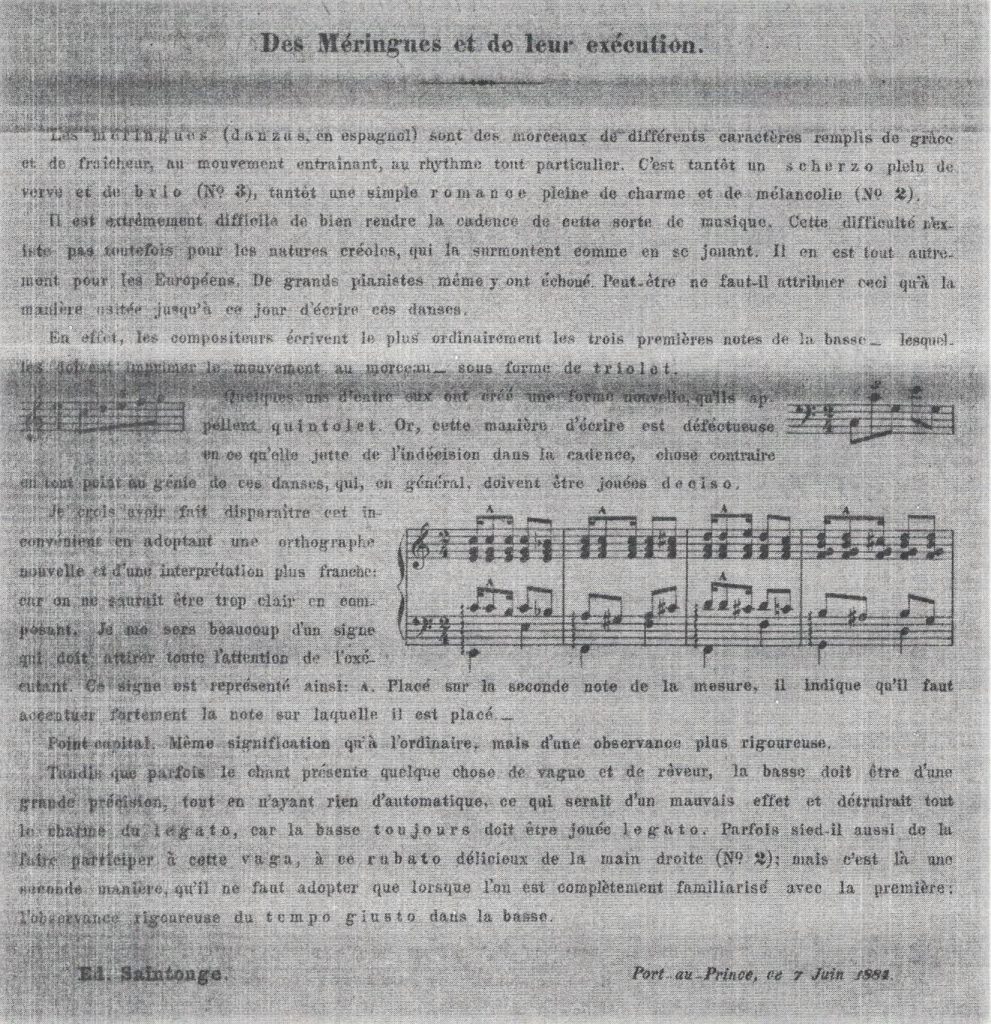
TRANSLATION OF PREFACE:
Méringnes and their performance
Les méringues (a Spanish Cuban danzes) are these pieces of different character full of grace and freshness with a compelling movement to an entirely particular rhythm. It is as much a scherzo full of verve and brio (No3), as much as a simple romance full of charm and melancholy (No2).
It is extremely difficult to accurately render the pace of this sort of music. This difficulty does not exist altogether for the native creoles who overcome it as it is played. It is altogether otherwise for Europeans. Formidable pianists themselves avoid it. Perhaps one should not attribute this but to the arduous manner in which to this day these dances are notated.
Effectively, composers ordinarily write the first three notes of the bass – which are printed of the movement- in the manner of a triplet. Some others have have created a new form they call a quintuplet (quintolet). However, this manner of notation is defective because it renders the pace imprecise something that is entirely at odds with the spirit of these dances which in general should be played decisively.
I believe I’ve eliminated this inconvenience in having adopted a novel notation and a more frank interpretation: because one can never be too clear when composing. I have frequently adopted a sign which should attract the attention of performers. This sign is representer thus: ^ placed on the second note of the measure indicates that one must forcefully accentuate the note over which it is placed.
Capital point. Same signification as before but observed more resolutely. As much as sometimes the song has a vague or dreamy character, the bass must retain a resolute precision avoiding all the while an automatic nature which would have a poor effect and destroy the charm of the legato for the bass should always be played legato. At times it must be granted to also participate in this vaga, in this delicious rubato of the right-hand (No2): but this is a second manner that should not be adopted until one is completely familiar with the first: rigorously observe the tempo giusto in the bass.
Ed. Saintonge Port-au-Prince, June 7 1884